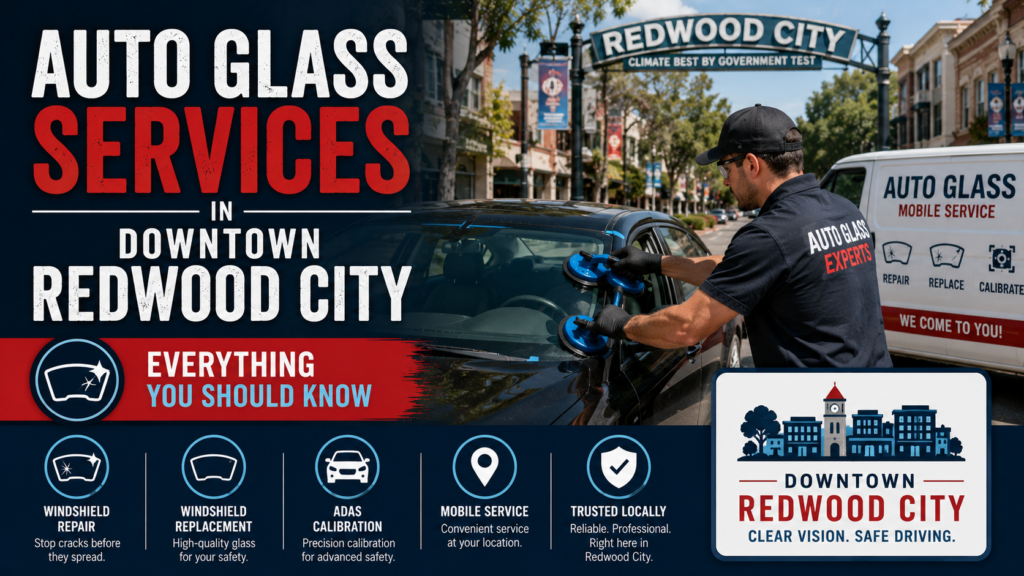
Downtown Redwood City is a bustling urban hub in the heart of San Mateo County a place where commuters, residents, and business owners are constantly on the move. With vehicles navigating busy intersections, parking structures, and the daily flow of Bay Area traffic, auto glass damage is an unfortunate but common reality for drivers in the area. From a stray pebble on the freeway to an overnight vandalism incident, windshields and vehicle glass can sustain damage at any time and often when least expected.
Understanding how auto glass works, what distinguishes a repair from a replacement, and what the service process actually involves helps Redwood City drivers make informed decisions when damage occurs. This guide covers the essentials of Auto Glass Shop Downtown Redwood City service the types of glass on your vehicle, how professionals assess and address damage, and why quality workmanship matters for your safety on the road.
Understanding Automotive Glass: More Than Just a Window
The glass on your vehicle is a critical safety component, not merely a cosmetic feature. Modern vehicles incorporate two distinct types of automotive glass, each engineered for a specific purpose and each responding differently to damage.
Laminated Glass (Windshields): Your front windshield is constructed from two layers of glass bonded together with a thin polyvinyl butyral (PVB) interlayer. This laminated construction means that when a windshield sustains impact damage, the outer layer may chip or crack but the structure as a whole tends to hold together rather than shatter into loose fragments. This is intentional the windshield is designed to remain intact during a collision to protect occupants from flying glass and to support the deployment of the front airbag. In a rollover accident, a properly installed windshield also provides structural support to the roof, preventing catastrophic collapse.
Tempered Glass (Side and Rear Windows): The side windows, rear window, and quarter glass panels on most vehicles are made from tempered glass glass that has been subjected to rapid heating and cooling to increase its strength. Tempered glass is significantly stronger than ordinary glass of the same thickness. When it does break, it shatters into small, rounded fragments rather than jagged shards, reducing the risk of laceration injuries. Unlike laminated glass, tempered glass generally cannot be repaired; damage typically requires full replacement.
Understanding these differences is the foundation for understanding why the assessment and treatment of auto glass damage varies so much depending on which piece of glass is affected and the nature of the damage.
Common Types of Auto Glass Damage
Auto glass damage comes in many forms, and the type of damage is one of the primary factors that determines whether repair or replacement is the appropriate response.
Rock Chips and Bull’s-Eye Damage: The most common form of windshield damage occurs when a small stone or piece of road debris strikes the glass at speed. This typically results in a chip a small area of damage to the outer glass layer. Depending on the size and shape, chips may appear as a bull’s-eye pattern, a star pattern, a half-moon, or a combination. When the damage fits within the size of a quarter roughly one inch in diameter repair is often a viable option.
Cracks: Cracks are linear fractures that extend across the glass. They can originate from an untreated chip that has spread due to temperature changes, vehicle vibration, or additional stress. A crack smaller than a dollar bill in length (approximately six inches) in an area away from the driver’s line of sight may be repairable. Larger cracks, edge cracks, or cracks that extend to the periphery of the windshield often indicate that the structural integrity of the glass has been compromised and replacement is necessary.
Edge Damage: Damage occurring within two inches of the edge of the windshield is particularly serious. Cracks that originate at or near the edge tend to spread rapidly and indicate structural compromise that repair cannot adequately address.
Driver’s Line-of-Sight Damage: Even a successfully repaired chip or crack leaves some optical distortion in the glass. For this reason, damage directly in front of the driver in the area swept by the primary wiper blade generally requires full replacement rather than repair, as even a minor optical irregularity in this zone can impair safe driving.
The Auto Glass Repair Process
When a chip or crack meets the criteria for repair typically smaller than one inch in diameter for chips, or under six inches for cracks in non-critical locations the process is efficient, effective, and relatively quick.
A trained technician begins by thoroughly cleaning the damaged area to remove any dirt, moisture, or debris that might interfere with the repair resin. A vacuum device is then applied over the damage to create a controlled environment, and a specialized polymer resin is injected into the chip or crack. The resin is formulated to have optical properties similar to glass when properly applied and cured, it bonds with the surrounding glass, restores structural integrity, and minimizes the visual appearance of the damage.
UV light is applied to cure the resin, which hardens it rapidly. The technician then polishes the surface to restore smoothness. The completed repair stops the damage from spreading and significantly improves the appearance, though a small blemish may remain visible under certain lighting conditions.
A quality repair takes less than an hour and allows the driver to return to the road the same day. It is far less intrusive than full replacement and, when the damage qualifies, is the preferred approach from both a cost and sustainability perspective.
The Windshield Replacement Process
When damage is too extensive for repair, full windshield replacement is required. This is a more involved process, but a trained technician can typically complete it within two hours.
The technician begins by carefully removing the existing windshield using specialized cutting tools and release agents to break the urethane adhesive bond between the glass and the vehicle frame. The pinch weld the metal channel around the windshield opening is cleaned and any remaining adhesive or debris is removed. Any corrosion or damage to the pinch weld is addressed at this stage.
A fresh bead of automotive-grade urethane adhesive is applied to the pinch weld, and the new windshield is carefully positioned and pressed into place. The urethane must be given adequate time to cure before the vehicle is driven typically a minimum of one hour, though some adhesives require longer cure times depending on temperature and humidity.
During this safe drive-away time (SDAT), the adhesive achieves sufficient bond strength to secure the windshield in the event of an accident. Driving the vehicle before this period has elapsed risks compromising the bond and, in a worst-case scenario, the windshield’s structural performance in a collision.
OEM vs. Aftermarket Glass: What’s the Difference?
A question that frequently arises when windshield replacement is needed is whether to use OEM (Original Equipment Manufacturer) glass or aftermarket glass. Both options have their merits, and the right choice depends on the vehicle and the driver’s priorities.
OEM glass is manufactured to the exact specifications of the original windshield installed by the vehicle manufacturer. It is identical in dimensions, curvature, tinting, coating, and acoustic properties to the factory glass. For vehicles equipped with rain sensors, heated windshields, acoustic interlayers, or heads-up display (HUD) systems, OEM glass ensures compatibility with these features.
Aftermarket glass is produced by independent manufacturers to match OEM specifications. High-quality aftermarket glass from reputable manufacturers meets or exceeds ANSI Z26.1 safety standards and in most cases is functionally equivalent to OEM glass. For standard vehicles without specialized glass features, quality aftermarket glass is a reliable and cost-effective option.
The key is ensuring that whatever glass is used, it meets safety standards and is installed by a certified technician using proper adhesives and techniques.
ADAS Calibration: A Modern Necessity
Advanced Driver Assistance Systems (ADAS) represent one of the most significant technological developments in vehicle safety in recent decades. Features such as automatic emergency braking, lane departure warning, adaptive cruise control, and forward collision alert rely on cameras and sensors that are mounted to or near the windshield.
When a windshield equipped with these systems is replaced, the camera or sensor must be recalibrated to ensure it operates correctly within the parameters designed by the vehicle manufacturer. Without proper calibration, ADAS features may not function accurately producing false alerts, failing to detect hazards, or providing incorrect guidance.
Calibration can be performed through two methods: static calibration, which is performed in a controlled indoor environment using target boards and diagnostic equipment; and dynamic calibration, which involves driving the vehicle under specific conditions until the system self-calibrates using real-world data. Some vehicles require a combination of both.
In Downtown Redwood City and throughout the Bay Area, the prevalence of newer vehicles with ADAS technology makes calibration an increasingly important part of windshield replacement. Drivers should confirm that their auto glass provider has the capability and equipment to perform calibration for their specific vehicle.
Mobile Auto Glass Service: Convenience Without Compromise
One of the most practical developments in auto glass service is the widespread availability of mobile repair and replacement. Rather than driving a vehicle with compromised glass to a shop which may be difficult or unsafe depending on the extent of the damage mobile technicians come directly to the customer’s location.
For drivers in Downtown Redwood City, where workday schedules are often demanding and parking is at a premium, mobile service offers a compelling convenience. A technician can perform both chip repairs and full windshield replacements in a parking lot, office garage, or residential driveway, typically completing the work within the same time frame as an in-shop visit.
The quality of mobile service is equivalent to shop-based service when performed by properly equipped and certified technicians. The primary variable is weather adhesives and resins perform best within specific temperature and humidity ranges, and technicians may need a covered work area or may reschedule if conditions are unsuitable for proper curing.
Why Prompt Attention to Auto Glass Damage Matters
One of the most consistent pieces of advice from auto glass professionals is simple: do not wait. A small chip that seems minor can spread into a crack within hours due to temperature changes, road vibration, or the pressure differential created when slamming a car door. A crack that might have been repaired for a modest investment can quickly grow beyond the threshold for repair, necessitating full replacement.
Beyond economics, driving with a damaged windshield carries real safety risks. Structural integrity is compromised. Visibility may be impaired. In California, driving with a cracked windshield that obstructs the driver’s view can result in a citation. And in the event of an accident, a windshield that is already cracked or improperly installed may not perform as designed.
For drivers in Downtown Redwood City, where the combination of urban traffic and highway commuting creates consistent exposure to road debris and the stresses that cause glass damage to spread, addressing auto glass issues promptly is one of the simplest and most effective safety investments a driver can make.